Episode 123: All of the Rant, None of the Rave
Watch the episode: https://www.youtube.com/watch?v=6KHx7RfTIt4
Quick Pour
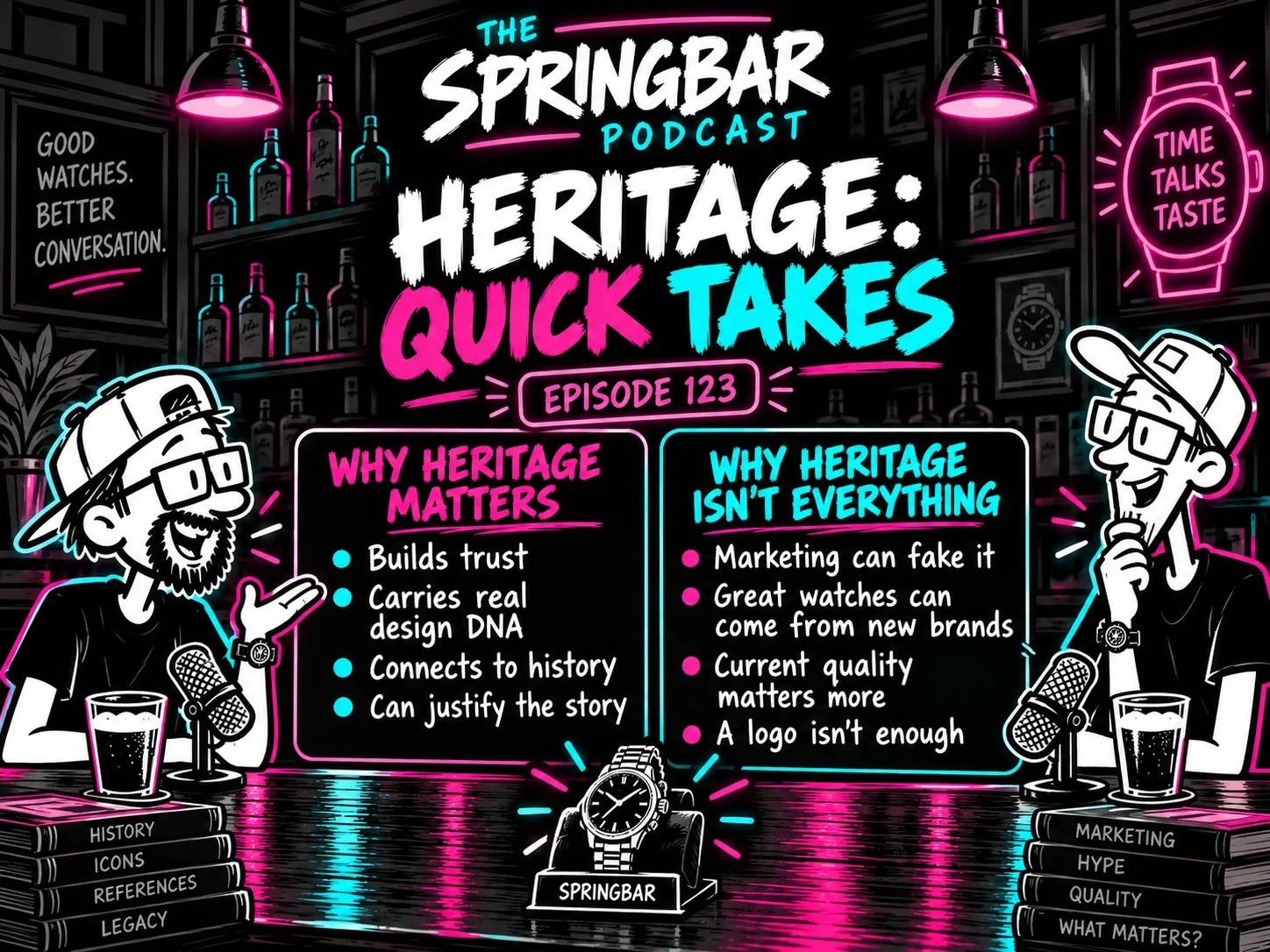
Some watch brands have been around for more than a century. Others were born on Kickstarter and haven't even celebrated their fifth birthday.
But here's the million-dollar question:
Does a brand's history actually make its watches better, or does it just give the marketing department a really good story?
In Episode 123 of The Springbar Podcast, an Instagram debate gets Mike fired up about heritage, microbrands, and whether established watchmakers have earned the right to use their history as a selling point.
Joe, naturally, has a few things to say about that.
And suddenly we're talking about everything from legendary Swiss manufacturers to watches that seem suspiciously familiar.
Not every watch has a story. And not every story deserves a premium.

The Debate in One Sentence
Mike says: If a watch brand has spent decades building its reputation, it has absolutely earned the right to celebrate and market that heritage.
Joe says: History matters, but it shouldn't excuse lazy design, questionable storytelling, or a lack of innovation.
And neither is entirely wrong.
Fast Takeaways
Mike's take
A century of watchmaking history has real value.
Established brands have earned their reputations.
Heritage can create an emotional connection with collectors.
Big brands shouldn't have to downplay their achievements to make microbrands feel competitive.
A compelling story can be part of what makes a watch desirable.
Joe's take
Heritage isn't an automatic guarantee of quality.
Some brands lean too heavily on their past.
Revived brand names don't always represent the original company.
Marketing claims deserve scrutiny.
A manufacturer's current designs should be able to stand on their own.
The real argument? Whether heritage is something a brand has earned - or something its marketing department can borrow.
Watches and Brands That Came Up at the Bar
Mentioned in the conversation
Audemars Piguet - Code 11.59 and Royal Oak
Rolex - 1908 and Cellini
Jaeger-LeCoultre - Reverso
Blancpain - Fifty Fathoms
Panerai
Universal Genève
Accutron
Bulova - Lunar Pilot, Oceanographer/Devil Diver, and Super Seville
Omega - Speedmaster
Timex - Q Marbela and Atelier
Citizen - Eco-Drive
Tournek-Rayville and other revived names
That's quite a lineup.
And each raises a slightly different question about what a brand's history is actually worth.
The Three Biggest Heritage Arguments
1) Is history a competitive advantage - or an unfair advantage?
The conversation starts with an argument Mike encountered on Instagram.
The claim: established watch brands use their history and heritage as marketing weapons against smaller brands.
Mike isn't buying it.
His position is simple:
If a company has survived for generations, developed recognizable products, and built a loyal following, why shouldn't it use that history to attract customers?
A new brand doesn't get the same backstory overnight.
But that doesn't mean it can't compete with:
Better design
Better specifications
Stronger value
Fresh ideas
A compelling story of its own
Heritage might open the door. But a great watch still has to walk through it.
2) What happens when a brand's history gets complicated?
Here's where Joe pushes back.
A manufacturer might have a famous name, an impressive archive, and decades of watchmaking achievements.
But what happens when the original company closes, someone buys the trademark, and a new business starts selling watches under that historic name?
Is that the same heritage?
Or simply the same logo?
The conversation brings up names including Universal Genève, Panerai, Blancpain, Accutron, and Sheffield.
The questions get interesting:
Does owning a historic name mean inheriting its achievements?
Should interrupted production matter?
How much of the original company still exists?
Are the historical marketing claims accurate?
Does the modern watch actually honor that history?
Mike acknowledges there's a significant gray area when companies are revived.
Joe's concern is that a compelling narrative isn't necessarily the same thing as a continuous history.
3) Are collectors paying a heritage tax?
Now things get interesting.
Mike brings up a debate comparing two Bulova watches:
Lunar Pilot: celebrated for its spaceflight connection.
Oceanographer/Devil Diver: a beloved dive-watch design with its own heritage.
His frustration? Criticizing one watch for charging a heritage premium while praising another heritage-inspired model without applying the same standard.
Joe brings Omega's Speedmaster into the discussion.
Suddenly, we're talking about one of watch collecting's favorite arguments:
How much are you paying for the actual watch, and how much are you paying for its story?
Craftsmanship matters.
Materials matter.
Design matters.
But emotional connection matters, too.
And there's no universal formula for pricing nostalgia.

Best Point of the Episode
One of the most interesting moments comes when Mike and Joe discuss the Timex Q Marbela.
Timex has an enormous design archive.
But this particular release reminds them of several existing luxury sports watches.
Mike is frustrated that a company with so much original history would release something so derivative.
Joe raises the business argument: a familiar, commercially appealing watch might sell well, even if it isn't particularly innovative.
And that brings the debate full circle.
If history is such a valuable asset, shouldn't it inspire original design instead of replacing it?
A brand can:
Celebrate its past
Reinterpret iconic designs
Experiment with new ideas
Create something its future collectors will remember
After all, every historic watch was new once.
Where Mike and Joe Actually Landed
Heritage is meaningful when:
The history is authentic.
The manufacturer has genuinely contributed to watchmaking.
Current products live up to the reputation.
The storytelling reflects the actual company.
Tradition inspires the next generation of designs.
Heritage becomes questionable when:
The logo carries more weight than the watch.
Historical claims are stretched.
Revived companies present complicated histories as uninterrupted.
Familiar designs replace genuine creativity.
The story becomes an excuse for an underwhelming product.
And there's room at the bar for microbrands, too.
A smaller company might lack a century of history, but that doesn't mean it lacks craftsmanship, ambition, or a great idea.

Final Pour
So, does watch brand heritage actually matter?
Absolutely. But it isn't everything.
History can make a watch more interesting. It connects collectors to craftsmanship, innovation, and moments that happened long before they ever walked into a watch shop.
But a hundred-year-old logo doesn't automatically make a mediocre watch extraordinary.
And a five-year-old company doesn't need a century of history to make something worth owning.
Maybe the real question isn't how long a brand has existed.
It's whether the watch on your wrist deserves to become part of that history.
Because yesterday's innovation is tomorrow's heritage.
And you can't build tomorrow's legends by living entirely in yesterday.
Pull Up a Stool
Time to settle this one at the bar.
Would you pay more for a watch because of its history?
Can a revived brand legitimately claim the achievements of the original manufacturer?
Have you ever chosen a microbrand over a big-name watchmaker?
Which watch brand is doing the best job of honoring its past while creating something new?
And the big question:
If two watches were identical in quality and design, would you pay more for the one with 100 years of history?
Mike and Joe want to hear what you think.

• THE BAR • ON TAP • THE BARTENDERS • PULL UP A STOOL • WATCH • LISTEN • FOLLOW • SHOP •